What to do when you cannot answer the phone
Hairdressers, beauticians and clinics miss calls because they are with a client. Voicemail leaks. A missed-call text or a simple AI receptionist is enough. You do not need to build an assistant. The one-page site already has a booking form.
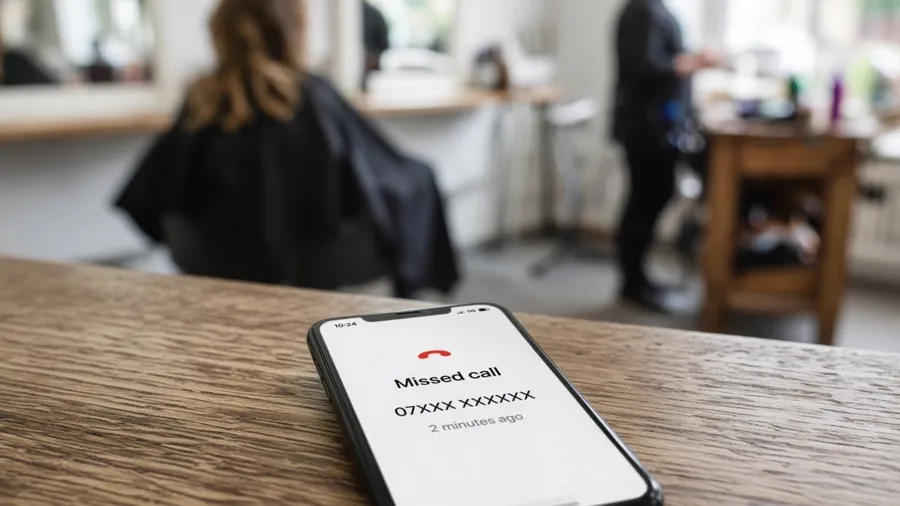
The phone rings while you have colour on a client, or a needle in someone’s eyebrow, or a patient on the couch. You cannot pick up. The default is voicemail. Most callers will not leave a message. Many will ring the next salon on Google instead. Returning the call an hour later, even diligently, often means the booking has already gone.
This is not a software problem first. It is a timing problem. The person who called wanted a slot now. Your hands were busy. The useful question is which tool sits in that gap without needing you to build an AI assistant from scratch.
Why voicemail leaks
Widely cited industry figures, mostly from US call audits and then recycled by vendors, put unanswered small-business calls somewhere between a third and two thirds of inbound volume. One often-quoted observational study of 85 small firms found only about 38 per cent of calls answered by a person. Voicemail abandonment is routinely put at 80 per cent or more. Treat the exact percentages as directional, not a census of British high streets. The pattern is still familiar to anyone who has run a chair-based business.
Speed matters more than courtesy. Research that is actually old, and still used because it has not been replaced, found that sales leads contacted within five minutes convert far better than leads contacted after half an hour. A salon callback after the last client of the morning is not five minutes. It is often two hours, plus lunch.
Put that into salon money rather than trade-job money. A missed call that would have booked a cut-and-colour at £70 to £120 is not a £70 loss if that client would have returned four times a year. It is also not automatically a lost client. Some people do wait. The leak is the ones who do not: new clients comparing two salons on their lunch break.
A booking form on your own site does not close the hole on its own. It is good at the people who already intended to book online. It does nothing for the person who is standing outside, or driving, and taps the phone number on your Google listing. Those calls still arrive at the worst moment.
The options, in order of fuss
There are five practical layers. You can stack them. You do not need all five.
- Make it easier not to call: a working online booking link on Google, Instagram and the website.
- Catch the miss with a text: automatic SMS when a call rings out.
- Answer the call with software: an AI receptionist that speaks, takes details, and can book or take a message.
- Answer the call with a person: a virtual receptionist service.
- Add a website or WhatsApp chat for the people who never ring.
Chatbots are last for a reason. They help the people already on your site. They do not pick up the ringing phone.
Layer 1: stop some of the calls happening
If you do not already have a booking form on your own site, start there. It is the cheapest way to cut inbound volume. The one-page sites already include a booking form. You do not need a separate booking marketplace.
Put that form link in four places and keep it the same link: Google Business profile, Instagram bio, website header, and the voicemail message. A surprising number of missed calls are people who would have booked themselves if the button had been obvious.
This does not replace the phone. Older clients, last-minute gaps, and “have you got anything this afternoon” still come by voice. It just means the phone is no longer doing every job.
Layer 2: auto-text the missed call
This is the first tool that actually addresses the ring you could not answer.
How it works: a missed call (no answer, or voicemail) triggers an SMS to the caller’s mobile within seconds. The text says you are with a client, asks what they need, and points them at a booking link or a reply. You keep your existing number. When you do answer, nothing happens.
For a hairdresser or clinic this is usually the best first spend. It does not try to hold a conversation about a fringe. It stops the caller hanging up into a void.
UK products aimed at trades and local services include TextTheCaller at £6.49 a month for 50 missed-call texts, Missed Call Hero, and Vexlo. Agencies such as Hand On Web start from about £49 a month with a booking-link message. AlwaysOn Booking sits higher, around £197 a month plus setup, because it bundles a diary and reminders. You do not need a full CRM stack to send one text.
A usable salon message is short:
“Hi, sorry we missed your call. We are with a client. Reply with what you need or book here: [link]. We will call back when we are free. [Salon name]”
Keep it under 160 characters if you can. Sound like the shop, not a call centre.
Limits of this layer:
- It only works if the caller is on a mobile. Landlines and withheld numbers get nothing.
- It does not book the appointment. The person still has to tap a link or wait for you.
- If your Google listing shows a landline that cannot send SMS, the provider has to sit in front of that number with a divert. That is the bit that feels technical. Reputable UK services set the divert for you. You should not have to touch Twilio.
- Fifty texts a month is plenty for a quiet chair. A busy high-street salon missing 10 calls a day will blow a 50-text cap. Check the overage before you sign.
On price, this is the only layer that can cost less than a colour appointment.
Layer 3: an AI receptionist that actually answers
This is not a website chatbot. It is a voice on the line. The caller hears a greeting, can say what they want, and the system takes a name, number, service and preferred time. Better products text or email you a summary. Some connect to a calendar and book the slot.
UK-priced examples that do not require you to train a model:
- Hey Jodie: flat plans published at £49, £99 and £199 a month with unlimited minutes. The pitch is that it captures the job and texts you.
- IONOS AI Receptionist: £39 a month ex VAT for 30 calls, £69 for 100 with calendar booking, £99 unlimited. A large hosting company, not a two-person startup. Prices rose after launch, so check the live page.
- Moneypenny now sells an AI receptionist as well as humans. The AI starting figure is advertised from about £25 a month. Full rates are quote-based. Useful if you already like the brand and want a human backup later.
- ReceptionHQ and similar firms start cheap on paper (from around £15) and then add usage. Read the minute bundle.
- US tools such as Rosie, Smith.ai and Ruby work, but they bill in dollars and are built around US numbers. Fine if you enjoy that stack. Awkward if you want a UK invoice and a UK accent.
What you are buying is coverage while you cut hair. What you are not buying is judgement. AI is good at “Saturday at 11 for a blow dry” and bad at “my colour went wrong and I am upset.” Clinics that handle clinical questions, safeguarding or anything that should not be guessed should set a tight script: take a message, offer a callback, do not advise.
Setup without a science degree looks like this:
- Write opening hours, services, prices you are willing to say out loud, and what the bot must never do.
- Point a “no answer” divert at the provider’s number, or give them your current number and let them place a call-forward. On BT and most UK landlines, divert-on-no-answer is
*61*[number]#. Cancel with#61#. Mobile networks use the same idea in Settings, Call forwarding. - Test it yourself from another phone. Then test it while you are with a client.
- Read the first 20 transcripts. Fix the script. That is the whole “training.”
If a salesperson says you need an API integration and a developer, you are in the wrong product. Calendar booking should point at the diary or booking form you already use on your own site.
Cost trap: per-minute and per-call plans look cheap at 20 calls and ugly at 80. A five-minute booking conversation on a £1.75-per-minute human service is nearly £9 before the monthly fee. Flat AI plans exist specifically to avoid that surprise.
Layer 4: a human on the other end
Sometimes you want a person. Medical and dental front desks, clinics with anxious first-time callers, and any business where a wrong booking is a clinical problem still have a case for a human virtual receptionist.
Moneypenny and ReceptionHQ also sell human cover. Other UK names include AnswerConnect, Face for Business and AllDayPA. Published starting prices run from about £15 a month for message-taking up to £200-plus for a meaningful minute bundle. Third-party snapshots of Moneypenny’s human plans often land around £99 to £280 a month before out-of-hours extras. 24/7 human cover is the expensive part. Evening add-ons of £25 to £150 are common.
A full-time receptionist is a different decision. Glassdoor-type salary figures around £24,000 a year become £28,000 to £35,000 once you add National Insurance, pension and cover. That is the right buy if you also need someone in the room to greet walk-ins and take payment. It is the wrong buy if the only problem is the phone ringing during treatments.
Human services still need a divert. They still need a script. They are not “set and forget” if your price list changes every season.
Layer 5: chat, WhatsApp and “AI assistants” that are not the phone
A website chatbot, Instagram DM automation or WhatsApp Business greeting helps the people who already chose not to call. Use them. Do not confuse them with a missed-call fix.
WhatsApp Business can auto-greet after hours and point people at a booking link. That is useful. It does not fire when someone taps the phone number on Google.
Building your own voice agent with Twilio, 3CX and a large language model is possible. It is exactly the “vibe code an AI assistant” path this piece is trying to avoid. You will spend evenings on webhooks, sender IDs and PECR. The monthly saving versus a £49 product disappears in your time.
What it actually costs
Rough UK bands for a single-site salon or small clinic in 2026:
- Your own site booking form: already included on the one-page site. No extra marketplace fee.
- Missed-call SMS only: about £6 to £50 a month at low volume. £49 to £100 if an agency sets it up and writes the message.
- AI voice receptionist: about £40 to £100 a month on published flat or per-call plans. £150 to £300 if you buy a bundled “we handle everything” package.
- Human virtual receptionist: about £100 to £400 a month for useful cover. More if you want nights and weekends.
- In-house receptionist: roughly £2,000 to £2,500 a month fully loaded, plus recruitment.
One recovered new client a month at a mid-ticket salon service pays for layers 2 or 3. That is the whole business case. Do not build a spreadsheet with vendor “£4,000 a month leakage” claims unless you have counted your own missed calls for two weeks.
Count them. Your phone’s recents list is better evidence than a blog statistic. Note how many rings you miss in a normal Tuesday. Multiply by your typical first-visit value. That is the budget.
Setup that does not need a developer
The technical piece is almost always call forwarding, not artificial intelligence.
On a BT-style landline: pick up the handset, dial *61* then the provider’s number then #. That forwards unanswered calls and leaves the phone free to ring first. Divert-all (*21*) sends every call away, including the ones you could have taken. Use divert-all only when the shop is closed.
On an iPhone or Android work mobile: Settings, Phone or Calling accounts, Call forwarding, forward when unanswered. Some networks charge for forwarded legs. Check the plan. Cloud phone systems (CircleLoop, 3CX, RingCentral, Vonage) do the same job in a web dashboard.
Sender name on the SMS should be the salon, not a random short code the client will ignore. UK providers handle registration for that. You should not be filling Ofcom forms yourself.
Test from a friend’s mobile, not from the shop phone. Listen to the greeting. Hang up mid-sentence. Book a dummy slot. Then delete the dummy slot.
Rules you cannot ignore
A missed-call text that only says “sorry we missed you, reply or book here” is a service message about a call the person just placed. That is different from a marketing blast.
UK rules still bite if the text becomes an offer, a “10 per cent off if you book today,” or a newsletter sign-up. PECR restricts unsolicited marketing texts. The ICO treats promotional wording as marketing even when you dress it as a service update. Keep the first auto-text factual. Put the sale in the booking page, not in the SMS.
You are processing a phone number. Have a one-line note in your privacy policy. Do not store transcripts of clinical details in a random US inbox if you run a regulated clinic. Ask where the audio lives.
Do not auto-text withheld numbers by trying to be clever. You cannot. Do not buy a list of “missed callers” from anyone.
What to choose
If you are a sole trader hairdresser, barber or beautician and you miss a handful of calls a day: turn on online booking properly, then add a missed-call text at the cheap end. Read the replies at lunch. Call back the ones that did not book themselves. That is the practical solution.
If you already have a full diary, evening enquiries and a booking system you like: add an AI receptionist on a flat monthly plan and give it permission to offer live slots. Keep a rule that complaints and patch-tests come to you.
If you are a clinic where the first sentence might be a symptom: use a human answering service during hours, or an AI that is only allowed to take a name and a callback time. Do not let a bot triage.
If you have a receptionist two days a week: divert to the missed-call text or the AI on the other days. Do not run both on top of a person who is sitting there. Double answering annoys callers.
Chat widgets and Instagram automations are extras. Fit them after the phone is no longer dropping new clients on the floor.
What not to do
Do not rely on “I always ring back.” You might. The client has already gone.
Do not record a two-minute voicemail essay. People hang up during the essay.
Do not buy a £300-a-month platform because it also posts to Google reviews, runs SMS reminders and offers a CRM. Buy the missed-call fix. Add reminders later if no-shows are the next problem. Reminders and missed-call recovery are different jobs.
Do not pick a US per-call plan because a podcast liked the brand. Check GBP, VAT, and whether the voice sounds like it works in Birmingham.
Do not hide the phone number to force online booking. Some clients will not use the app. You will not hear from them. You will also look closed.
Balanced assessment
There is no single gadget that makes a busy chair into a reception desk. The leak is real. Voicemail is a poor plug. Auto-text is the affordable, low-skill fix that most independent salons and small clinics should try first. AI voice receptionists have become cheap enough, in 2026, to be a sensible second step when you want the call answered rather than acknowledged. Human answering services still earn their fee where the conversation is sensitive. Website chatbots do not replace any of that.
The test is simple. Miss a call on purpose this week. See what the caller gets in the next 30 seconds. If the answer is silence or a voicemail beep, that is the system you have. Change that system before you change your advertising.
Key sources
- 411 Locals small-business call audit (often cited: about 38 per cent of calls answered live).
- BIA/Kelsey and related industry research on phone-lead conversion versus web forms.
- Hiya and similar call-intelligence reports on voicemail abandonment.
- Harvard Business Review / MIT lead-response work on contacting enquiries within minutes.
- TextTheCaller public UK pricing for missed-call SMS.
- Hey Jodie and IONOS published UK AI receptionist prices, August 2026.
- ReceptionHQ, AnswerConnect and third-party Moneypenny price snapshots for human answering.
- ICO Guide to PECR on marketing texts versus service messages.
- BT and UK network call-divert codes for no-answer forwarding.
- The one-page site booking form as the online layer that does not, on its own, answer the phone.